
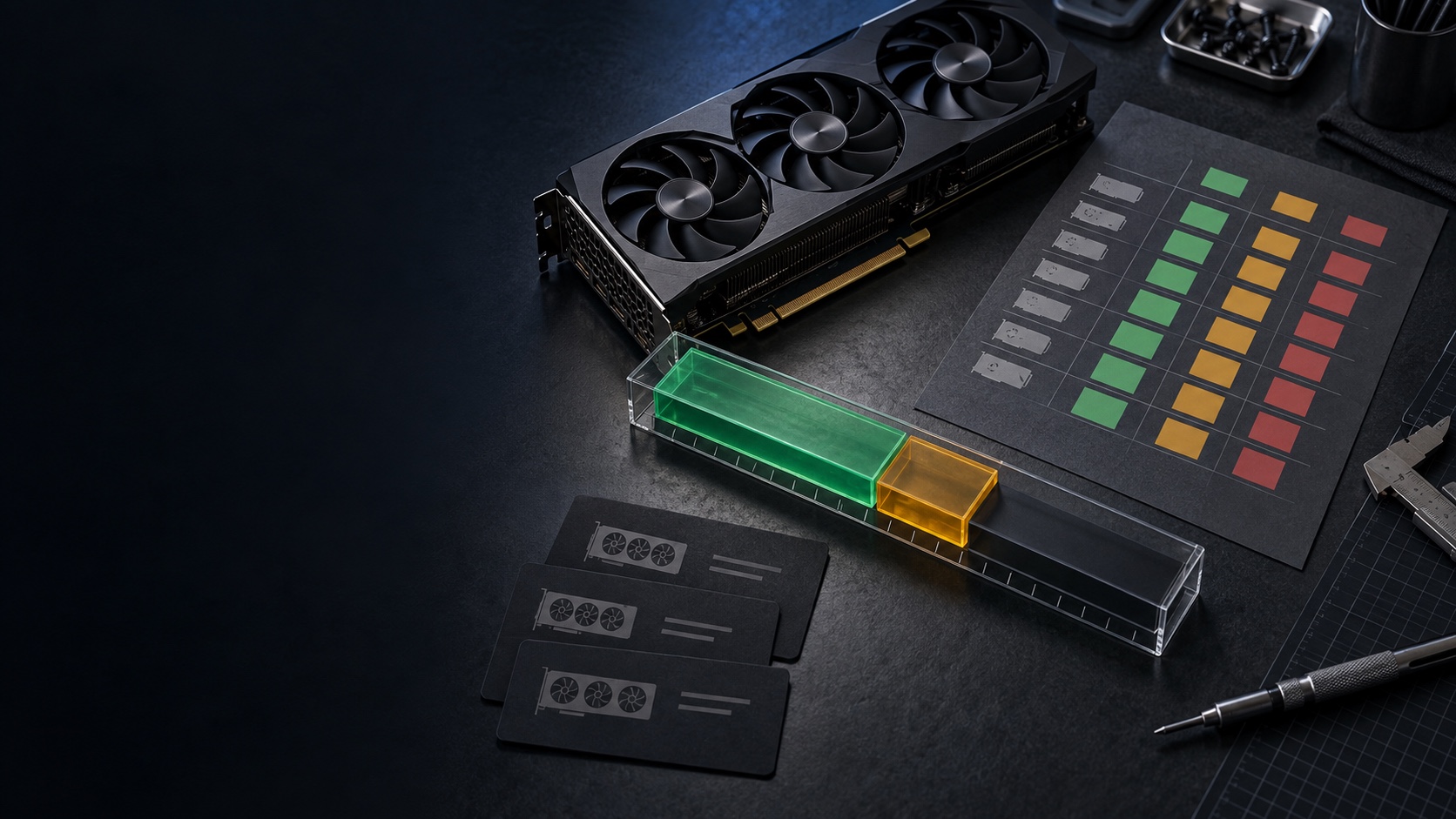

Local Model Fit Sheet
Enter the cards you own once, pick a model, and see which quantisations fit and how much context each one leaves. The cache arithmetic is computed from each model's published architecture, so it accounts for grouped-query attention and sliding windows instead of assuming every model is shaped the same.
1 Machines
Save each machine once. Every fit check then uses its GPU memory without asking you to enter it again.
This browser will not keep saved work — storage is blocked, or this is a private window.
2 Models
Choose a shipped architecture, or add a newer model from its config.json. Pasted configs are read here and never leave this browser.
This browser will not keep saved work — storage is blocked, or this is a private window.
3 Fit sheet
Compare quantisations and context lengths. Weights and cache stay separate so you can see what is using the memory.
This browser will not keep saved work — storage is blocked, or this is a private window.
4 Sources
Check the architecture figures behind the sheet. Every row links to the model config it was read from.
This browser will not keep saved work — storage is blocked, or this is a private window.
Where each number comes from.
The five constants the cache arithmetic needs — layers, KV heads, head
dimension, and the sliding-window shape — are read from each model's own
config.json, the same file the runtime loads. Every architecture row cites
the URL it was read from and the date.
Quantised file sizes are the reader's own. Whoever builds a GGUF publishes the exact byte size of every file, so the honest source for "how big is Q4_K_M" is the repository listing or the file already on disk, not a table here that would be stale the next time a repo is rebuilt. Where a size is not supplied, the weight figure is derived from the architecture and labelled an estimate.
What this cannot know. The figure is memory the model and its cache need, not memory a runtime will use. Allocator overhead, CUDA context, the compute buffer, fragmentation and whatever else is on the card are all real and none of them are here. A result inside a couple of gigabytes of the limit should be read as "try it", not as "it fits".
Grouped-query attention and sliding windows are modelled, because ignoring
them is not a small error. Llama 3.3 70B has 64 query heads and 8 KV heads;
sizing its cache by query heads overstates it eightfold. Gemma 3 attends to a
1024-token window on five layers out of every six, so treating it as full
attention at 128k context overstates the cache by roughly an order of
magnitude. A sliding_window key alone is not evidence of either — Qwen2.5
sets one and disables it.
No benchmark scores, no quality rankings, no recommendation about which model to run. Which model is better is not a fact about a config file, and a shipped opinion is the one thing here nobody could check.
Saved work stays in this browser. This product needs no account and offers none; download a backup before clearing browser data or moving machine.
Your copy
Download everything saved in this browser, or restore a backup on this device.